




Disclaimer: This post is for academic purposes only. Please read the original document if you intend to use them for clinical purposes.
Tuberculosis (TB) remains a severe global health crisis. It is both a cause and a consequence of poverty, disproportionately affecting vulnerable populations and generating severe financial strain. To confront this challenge, the WHO and the International Labour Organization (ILO) established a comprehensive Monitoring and Evaluation (M&E) framework in 2026. This framework complements the WHO Guidance on social protection for people affected by TB and provides a roadmap for tracking progress toward universal social protection coverage.
Advertisement:

1. Global Context:
Burden
TB disproportionately burdens individuals living in poverty, informal economy workers, migrants, miners, prisoners, and people living with HIV. Beyond direct health impacts, TB imposes severe financial shocks:
- In 2024, 2.7 million people with TB were either undiagnosed or not notified to national authorities, facing substantial barriers to care and social exclusion.
- The UHC Service Coverage Index (SDG Indicator 3.8.1) among the 30 high TB burden countries remains low (ranging between 40 and 60).
- Public expenditure on social protection (excluding health) among the 30 high TB burden countries reveals acute underinvestment: 22 of these countries allocate less than 5% of their Gross Domestic Product (GDP) to social protection, ranging from 0% in the Central African Republic to 17% in Brazil.
Targets
M&E Framework bridges health interventions and social protection systems, aligning with several high-level global policy commitments:
- 2023 UNHLM Political Declaration on TB: Commits member states to ensuring that 100% of people with TB have access to a health and social benefits package by 2027.
- WHO End TB Strategy: Aims for a world free of TB with zero deaths, disease, and suffering, anchored by the target that 0% of TB-affected households face catastrophic costs.
- Sustainable Development Goals (SDGs): Supports SDG Target 1.3 (nationally appropriate social protection systems and floors for all) and SDG Target 3.8 (Universal Health Coverage).
- The Sevilla Commitment (2025): Urges countries to expand fiscal space for social protection, increasing coverage by at least 2 percentage points per year in countries without universal coverage.
- Doha Political Declaration (2025): Calls for sustained investment in universal, inclusive, and sustainable social protection systems.
SDG Health Expenditures vs. Catastrophic Total Costs
It is critical to distinguish between general population health expenditure tracking and TB-specific financial strain.
| Feature: | SDG Indicator 3.8.2 (UHC Health Spending): | WHO End TB Strategy Indicator (Catastrophic Total Costs): |
| Target Population | General population (includes non-users of health services). | Specific population: Diagnosed people with TB utilizing National TB Programme (NTP) networks. |
| Costs Included | Direct out-of-pocket health expenditures across all conditions. | Direct medical payments + direct non-medical payments (transport, lodging) + indirect costs (lost income). |
| Threshold | Large household spending on health as a share of total expenditure/income (e.g., >10% or >25%). | Total TB-related direct and indirect costs exceeding >20% of annual pre-TB household income. |
| Analytical Scope | Measures population-level financial burden of care seeking; cannot capture non-seeking barriers. | Captures deep, disease-specific economic impoverishment and complete household financial shock. |
Because TB causes severe income loss alongside direct and transport costs, the proportion of TB-affected households facing catastrophic total costs (47% globally in 2024) is significantly higher than general population catastrophic health expenditure rates under SDG 3.8.2.
2. Framework:
The framework defines three concentric target groups to capture how social protection impacts the TB continuum:
                  ┌──────────────────────────────────────────────┐
                  │                 OUTER CIRCLE                 │
                  │   Preventing TB among populations at risk    │
                  │ ┌──────────────────────────────────────────┐ │
                  │ │              MIDDLE CIRCLE               │ │
                  │ │  Improving outcomes for ALL people w/ TB │ │
                  │ │ ┌──────────────────────────────────────┐ │ │
                  │ │ │             INNER CIRCLE             │ │ │
                  │ │ │  Improving outcomes for DIAGNOSED    │ │ │
                  │ │ │        & NOTIFIED people w/ TB       │ │ │
                  │ │ └──────────────────────────────────────┘ │ │
                  │ └──────────────────────────────────────────┘ │
                  └──────────────────────────────────────────────┘
- Inner Circle — Diagnosed and Notified People with TB:
- Focus: Directly supported by TB-specific and TB-sensitive social protection (e.g., cash transfers, food packages, transport vouchers, sickness benefits, treatment adherence support).
- Feasibility: Highly actionable for immediate M&E via routine NTP surveillance and register linkages.
- Middle Circle — All People with TB (Including Undiagnosed/Unnotified):
- Focus: Captures the estimated 2.7 million undiagnosed or unnotified individuals facing financial and social barriers, stigma, or marginalization.
- Interventions: Universal benefit eligibility not conditional on TB notification, social health insurance enrolment (including informal sector workers), and care-seeking transport/nutrition subsidies.
- Outer Circle — Populations at Higher Risk of TB (Prevention Tier):
- Focus: Broader socioeconomic environment to prevent disease progression among high-risk groups (e.g., low-income households, informal workers, miners, prisoners, migrants, people living with HIV, malnourished individuals).
- Interventions: Social safety nets, food security programmes, housing improvement schemes, and workplace safety standards.
3. Model:
The framework establishes a results chain connecting initial investments to long-term impact:
INPUTS ───► PROCESSES ───► OUTPUTS ───► OUTCOMES ───► GOAL / IMPACT
Components of the Results Chain:
VISION: A World Free of TB Deaths, Disease, and Suffering
- Inputs (Resources & Enabling Conditions):
- Sustainable domestic and international financing; political commitment; legal frameworks and governance.
- Multisectoral collaboration across health, social welfare, labour, and finance ministries.
- Interoperable digital data systems connecting health surveillance with social protection registries.
- Processes & Activities (Interventions):
- Designing and scaling TB-sensitive and TB-specific support schemes (cash transfers, transport vouchers, nutrition packages, disability/sick pay).
- Training health and social service workers on identifying and referring eligible TB patients.
- Conducting anti-stigma campaigns, community engagement, advocacy, and operational research on benefit adequacy and timeliness.
- Outputs (Immediate Results):
- Increased enrolment of notified TB patients in social health protection and cash benefit schemes.
- Expanded coverage of free TB prevention, diagnosis, and treatment services.
- Establishment of digital platforms linking health registries to national social welfare databases.
- Outcomes (Medium-Term Effects):
- Achievement of 100% coverage under a combined health and social benefits package by 2027.
- Provision of adequate, timely (<1 month post-diagnosis), and comprehensive support.
- Reduction in direct out-of-pocket spending and income loss; improved treatment completion and success rates.
- Enhanced equity for marginalized populations (migrants, informal workers, low-income groups).
- Goal or Impact (Long-Term Transformation):
- Substantial reductions in TB incidence, mortality, and TB-induced household impoverishment.
- Strengthening of socioeconomic resilience and national health/social protection systems.
4. Indicators:
The framework categorizes indicators into core, proxy, expanded, and under-development tiers.
I) Core:
The framework centers on two direct impact and outcome indicators:
1. Percentage of People with TB Covered by a Health and Social Benefits Package (UNHLM Target Indicator):
This composite indicator combines health access and financial protection into a single metric:
- Component 1 (Health Benefits Package): Proportion of notified TB cases receiving the nationally defined package of essential health services (prevention, screening, diagnosis, treatment, and follow-up) free at the point of use.
- Component 2 (Social Protection Benefits): Proportion of notified TB cases receiving at least one form of social protection benefit (income support, cash transfers, food support, housing) before, during, or after treatment.
2. Percentage of TB-Affected Households Facing Catastrophic Total Costs Due to TB (End TB Strategy Indicator):
Defined as the proportion of TB-affected households whose total costs (direct medical + direct non-medical + indirect lost income) exceed 20% of annual pre-TB household income or expenditure.
In addition, monitoring must evaluate benefit delivery quality:
- Timeliness: Percentage of newly diagnosed people with TB receiving social support within 1 month (30 days) of diagnosis. The initial 30 days carry the highest economic vulnerability and risk of treatment dropout.
- Adequacy: The degree to which benefits (value, frequency, duration) offset actual direct medical, transport, and indirect income loss costs.
- Comprehensiveness: The extent to which benefits address multi-dimensional life cycle contingencies and risks.
II) Proxy:
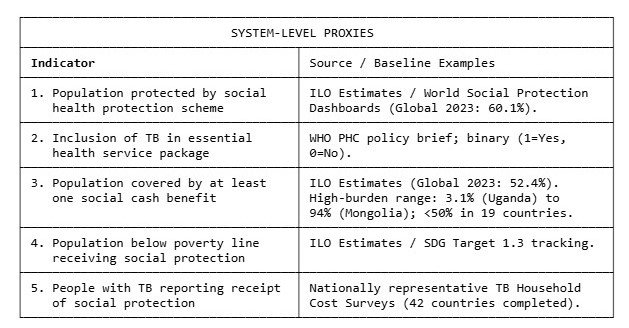
Because direct composite monitoring is under development in most countries, five proxy indicators provide an interim baseline using established ILO and WHO datasets:
Methodological Note on Joint Coverage Estimation
Countries lacking linked administrative databases can triangulate routine TB treatment coverage data with survey-derived social benefit rates to estimate joint coverage.
For example: If routine NTP data show a 90% (0.90) treatment coverage score, and a national TB household cost survey shows 40% (0.40) of TB patients receive social benefits, the estimated joint coverage is: 0.90 x 0.40 = 0.36 (36%)
III) Expanded:
To evaluate whether health and social systems are structurally prepared to serve people with TB, countries measure:
- Public Spending on Social Protection:
- GDP share spent on social protection, including health care (World Bank / ILO).
- GDP share spent on social protection, excluding health care (WHO Global TB Report).
- Policy Alignment:
- Formal inclusion of social protection strategies within National Strategic Plans (NSPs) for TB.
- Formal inclusion of TB as an explicit eligibility criterion within national social welfare laws.
- Workforce & Technical Infrastructure:
- Number of health and social service workers trained in TB social protection referral protocols.
- Establishment and functionality of digital TB-social protection linkage platforms.
- Equity-Focused Coverage:
- Effective coverage rates among high-risk groups (informal workers, migrants, miners, people living with HIV).
III) Under-development:
1. Coverage of people in vulnerable situations (including migrants, informal workers and people living with HIV)
2. Coverage of at-risk populations with social protection
5. Phases:
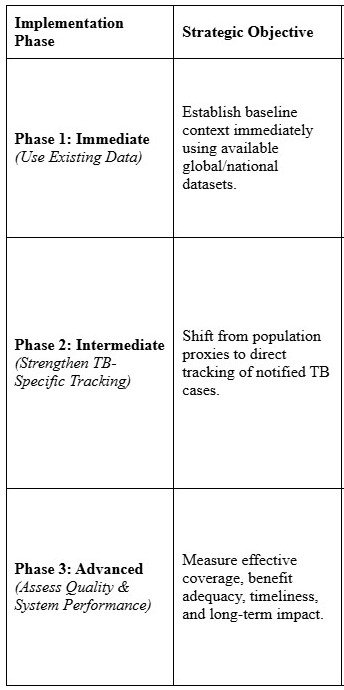
Implementation follows a three-phase maturation model, allowing immediate tracking while building digital capacity:
6. Progress:
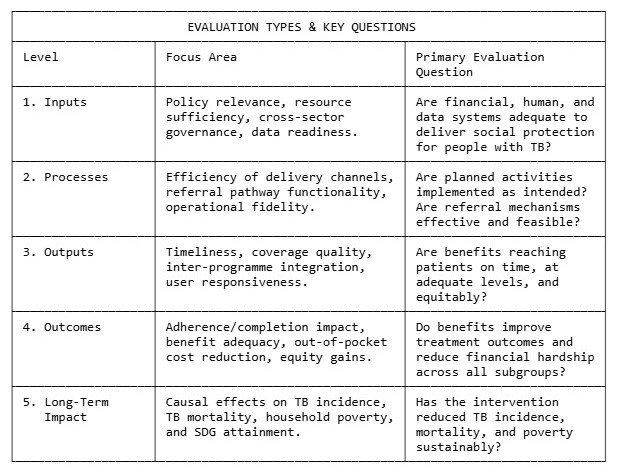
While routine monitoring tracks indicator counts, evaluation assesses causality, fidelity, efficiency, and sustainability.

Evaluation Typologies Across the Results Chain:
Cross-Cutting Evaluation Themes:
- Equity: Evaluates whether social protection effectively reaches marginalized populations (women, migrants, informal workers) or if structural barriers perpetuate exclusion.
- Cost-Effectiveness and Efficiency: Compares the economic cost per successfully treated TB patient receiving social support against standard care options to guide fiscal allocations.
- Learning and Adaptation: Translates evaluation findings into operational updates, policy briefs, and corrected implementation designs.
- Sustainability: Assesses whether interventions can be maintained through domestic fiscal space, institutional integration, and long-term political commitments.
7. Priorities:
To translate the M&E Framework into national action, health and social protection authorities should prioritize five implementation actions:
- Data Systems Integration & Interoperability: Build digital connections between NTP electronic registers and national social registries using unique individual identifiers to streamline referrals, reduce benefit duplication, and track real-time enrolment.
- Operational Research on Benefit Quality: Launch implementation research to collect empirical data on benefit timeliness and adequacy, utilizing sentinel surveillance systems where routine data are absent.
- Multisectoral Governance Mechanisms: Embed social protection monitoring into national multisectoral accountability frameworks (such as the WHO MAF-TB), bringing together health, social welfare, labour, and finance authorities alongside civil society.
- Alignment with SDG & UHC Reporting: Integrate TB social protection metrics into annual national health sector reviews, voluntary national reviews (VNRs) for SDGs, and international ILO/WHO global monitoring dashboards.
- Sustainable Domestic Financing: Secure long-term domestic budget lines for both TB-specific enablers (transport/nutrition support) and broad TB-sensitive social safety nets, reducing reliance on short-term donor funding.
Citation: Universal social protection inclusive of people with tuberculosis: monitoring and evaluation framework. Geneva: World Health Organization and the International Labour Organization, 2026. Licence: CC BY-NC-SA 3.0 IGO.