





Disclaimer: This post is for academic purposes only. Please read the original document if you intend to use them for clinical purposes.
This document summarises the Infection Prevention and Control (IPC) Practice Handbook published by the Clinical Excellence Commission, New South Wales (NSW), Australia. It establishes a robust, risk-based framework for preventing and controlling Healthcare-Associated Infections (HAIs) across all healthcare settings. The central tenet of the handbook is a systematic approach to risk management, underpinned by a clear hierarchy of controls that prioritizes risk elimination.
Advertisement:
1. Hierarchy of Controls and Risk Management
A systematic risk management framework is essential to preventing and minimizing harm from HAIs. This framework is not an additional task but an integral part of standard care.
1.1. Hierarchy of Controls:
Infection prevention and control hazards should be managed using a hierarchy of controls, which prioritizes the most effective measures.
| Control Level: | Description: | Examples in IPC context: |
| Elimination | Reduce opportunities or prevent infection entirely. | Vaccination programs, designing out infection risks in new builds. |
| Engineering Controls | Design facilities and systems to reduce infection. | Negative pressure rooms, appropriate ventilation (HVAC) systems, placement of hand hygiene facilities, use of safety-engineered sharps. |
| Administrative Controls | Implement policies, procedures, and training. | Hand hygiene policies, respiratory etiquette, staff training, screening protocols, antimicrobial stewardship programs, auditing. |
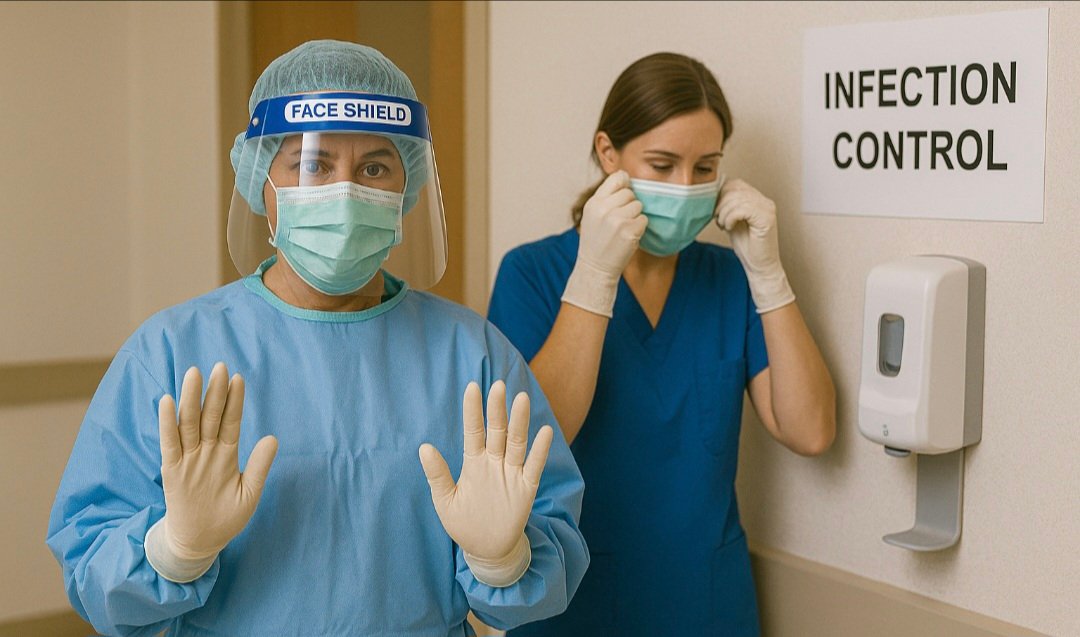
| Personal Protective Equipment (PPE) | Use protective barriers as a last line of defense. | Gloves, gowns, masks, respirators, and eye protection. |
1.2. Risk Management Process:
A successful approach to risk management is applied at organizational, departmental, and individual levels. It follows five fundamental principles:
- Establish the Context: Understand the setting, patient population, and types of clinical procedures being performed.
- Identify Infection Risks: Determine potential for infection in patients, health workers, or visitors, including risks from shared equipment or patient flow.
- Analyse and Evaluate Risks: Assess the likelihood and consequences of an identified risk.
- Treat and Manage Risks: Implement control measures according to the hierarchy of controls.
- Review Effectiveness of Control Measures: Monitor and evaluate the implemented controls to ensure they are effective and sustainable.
Risk assessment must be applied to patients (considering age, comorbidities, immune status), health workers (assessing illness, exposure history, vaccination status), functional areas, and the physical environment, including during construction and renovation.
2. A Two-Tiered Approach to IPC
There is a two-tiered approach to reduce the transmission of microorganisms in healthcare settings.
2.1. Standard Precautions:
Standard Precautions are the minimum IPC measures that apply to all patient care, regardless of suspected or confirmed infection status. They are designed to reduce the risk of transmission from both recognized and unrecognized sources of infection.
Components:
- Hand Hygiene
- Respiratory Hygiene and Cough Etiquette
- Personal Protective Equipment (PPE)
- Aseptic technique
- Safe management of Invasive Devices
- Needle-stick and Sharps Injury (NSI) Prevention
- Safe handling of Intravenous Solutions and Medications
- Reprocessing of Reusable Medical Devices (RMDs)
- Safe handling of Linen
- Environmental cleaning
- Biomedical waste (BMW) management
- Safe Handling of patient specimens
2.2. Transmission-Based Precautions:
Transmission-Based Precautions are implemented in addition to Standard Precautions for patients with known or suspected infections that are spread by specific routes. The decision to implement these is based on a risk assessment of the patient, the pathogen, and the environment.
| Precaution type: | Description & Transmission route: | Key management strategies: |
| Contact Precautions | For agents spread by direct or indirect contact with the patient or their environment (e.g., MDROs, C. difficile). | Single room preferred, use of gloves and gown/apron, dedicated patient equipment, enhanced environmental cleaning. |
| Droplet Precautions | For agents spread through large respiratory droplets generated by coughing, sneezing, or talking (e.g., influenza, pertussis). | Single room preferred, surgical mask for staff within 1.5m, patient wears a surgical mask when outside their room. |
| Airborne Precautions | For agents spread via small airborne particles (aerosols) that can remain suspended in the air (e.g., tuberculosis, measles, varicella). | Placement in a negative-pressure room, use of a fit-tested N-95 respirator for HCWs entering the room, restricted patient movement. |
3. Core Risk Mitigation Strategies
The handbook provides extensive detail on the practical application of infection prevention measures.
3.1. Hand Hygiene:
Effective hand hygiene is the single most important strategy to prevent HAIs.
- The 5 moments: Health workers must perform hand hygiene:
- Before touching a patient.
- Before a procedure.
- After a procedure or body fluid exposure risk.
- After touching a patient.
- After touching a patient’s surroundings.
- Product:
- Alcohol-Based Hand Rub (ABHR): The preferred method for most clinical situations when hands are not visibly soiled. The process should take 20-30 seconds.
- Soap and Water: Required when hands are visibly soiled, after contact with bacterial spores (e.g., C. difficile), or non-enveloped viruses (e.g., Norovirus). The process should take 40-60 seconds.
- Policy and Compliance:
- Bare Below the Elbow (BBE): Long sleeves must be pushed above the elbow. No hand, wrist, or forearm jewelry (except a plain band) should be worn during direct patient care.
- Nails: Must be kept short, clean, and natural. Artificial nails are prohibited for those in direct patient care.
3.2. Personal Protective Equipment (PPE):
PPE selection is guided by a risk assessment of the anticipated type and amount of exposure to blood and body substances.
- Gloves: Used to protect hands from contamination or to prevent organism transfer. Must be changed between patients and tasks, with hand hygiene performed before and after use.
- Gowns and Aprons: Worn to protect clothing and skin from contamination. An impervious or fluid-resistant gown is chosen when there is a risk of significant exposure to body fluids.
- Face and Eye Protection: Surgical masks and eye protection (goggles or face shields) are used to protect mucous membranes from splashes or sprays.
- Respirators (N-95): Used for airborne precautions to protect the wearer from inhaling hazardous airborne particles. Health care workers using tight-fitting respirators must be fit-tested to ensure an adequate seal.
3.3. Environmental Management:
A clean and well-maintained environment is critical for preventing the transmission of microorganisms.
- Cleaning and Disinfection: Cleaning involves the physical removal of soil with a detergent. Disinfection uses a chemical agent to eliminate pathogenic microorganisms. A risk-based approach determines the level and frequency of cleaning required.
- Facility Design: Building design should incorporate infection control principles, including smooth, easy-to-clean surfaces; appropriate ventilation (HVAC) systems; and proper placement of hand hygiene sinks. Carpeting should be avoided in clinical areas.
- Water Systems: Water features like decorative fountains and fish tanks are discouraged in clinical areas due to the risk of aerosolizing pathogens like Legionella.
- Waste Management: Clinical and related waste must be segregated, handled, and disposed of according to policy to prevent injury and infection.
3.4. Reprocessing of Reusable Medical Devices (RMDs):
They are categorized by risk (Spaulding classification) to determine the required level of reprocessing.
- Critical:Items that enter sterile tissue (e.g., surgical instruments). Must be sterilized.
- Semi-critical:Items that contact mucous membranes or non-intact skin (e.g., endoscopes). Require high-level disinfection at minimum.
- Non-critical:Items that contact intact skin (e.g., stethoscopes, blood pressure cuffs). Require cleaning and may need low-level disinfection.
The entire reprocessing cycle—from point-of-use cleaning to transport, cleaning, disinfection/sterilization, storage, and handling—must adhere strictly to manufacturer instructions.
4. Management of significant pathogens and conditions
4.1. Multi-Drug Resistant Organisms (MDROs):
MDROs are microorganisms resistant to one or more classes of antimicrobial agents (e.g., MRSA, VRE, CPE). A multi-pronged strategy is required for their management.
- Prevention Strategies:
- Consistent application of standard and transmission-based precautions.
- Screening of high-risk patients.
- Patient placement in single rooms or cohorting.
- Enhanced environmental cleaning and disinfection.
- Antimicrobial Stewardship (AMS): A crucial component to reduce the emergence of resistance. Programs must be in place to promote judicious antimicrobial use, guided by local antibiograms and therapeutic guidelines.
- Decolonization and Clearance: For some MDROs, such as MRSA, protocols for decolonization (e.g., with mupirocin nasal ointment and antiseptic body washes) are used to reduce the patient’s microbial load, particularly before high-risk surgeries. Clearance requires negative screening results over a defined period.
4.2. Clostridioides difficile (C. difficile):
Although not an MDRO, C. difficile requires special attention due to its spore-forming nature.
- Hand Hygiene: Spores are resistant to alcohol, so hand washing with soap and water is mandatory.
- Environmental Cleaning: A sporicidal disinfectant (e.g., a chlorine-based agent) is required for cleaning the patient environment.
- Precautions: Contact precautions should be maintained for at least 48 hours after diarrhoea resolves.
5. Specialized settings
Application of core principles to various specialized clinical contexts, including:
- Immunocompromised Patients: Require stringent adherence to standard precautions and may need placement in a “protective environment” with specific air quality controls (HEPA filtration, positive pressure).
- Cystic Fibrosis (CF) patients: To prevent cross-infection, CF patients must maintain a distance of ≥2 meters from each other. Segregation and specific scheduling are required in inpatient and outpatient settings.
- Haemodialysis units: Patients with Hepatitis B (HBsAg positive) must be treated in a separate room with dedicated equipment and staff where possible.
- Construction and Renovation: Strict environmental controls (e.g., dust barriers, negative air pressure, HEPA filtration) are required to protect patients, especially the immunocompromised, from airborne fungal spores like Aspergillus spp.
- Mortuary care: Standard and relevant transmission-based precautions must continue after death. Specific regulations apply to handling and labeling bodies infected with prescribed infectious diseases.
6. Governance, surveillance, and quality improvement
An effective infection prevention and control program relies on a strong governance framework and a culture of continuous improvement:
- HAI Surveillance: Health Organisations must undertake surveillance of HAIs using standardized definitions and clinical indicators to monitor infection rates, identify trends, and trigger investigations.
- Auditing: Regular audits of key practices, such as hand hygiene compliance are essential to measure performance and provide feedback for improvement.
- Incident Management: A formal process must be in place to manage clinical incidents. This includes:
- Lookback: A process to identify and manage patients who may have been exposed to a risk of infection (e.g., from inadequately reprocessed equipment).
- Open Disclosure: A process for open and honest communication with patients following a patient safety incident.
- Outbreak Management: The handbook outlines a systematic process for managing outbreaks, including establishing a case definition, forming an Outbreak Management Team (OMT), conducting investigations, implementing control measures, and communicating with stakeholders.
7. Environmental sustainability
The handbook acknowledges the environmental impact of healthcare and advocates for integrating sustainability into infection control practices without compromising safety:
- Circular Economy Principles: Encourages exploring reuse, repair, and recycling to reduce waste and carbon emissions.
- Single-Use vs. Reusable Devices: Promotes a risk-based approach when choosing between single-use and reusable items, balancing safety, cost, and environmental impact. The reprocessing of items designated as single-use is strictly prohibited.
- Risk Assessment for new technologies: A formal risk assessment is required when considering new “green” cleaning products or technologies to ensure they are as effective as existing methods and do not introduce unintended consequences.
Citation: Clinical Excellence Commission, 2025, Infection Prevention and Control Practice Handbook, v4.0, Sydney, Australia